|
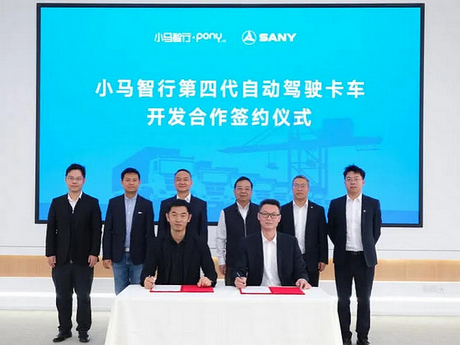
SANY Group recently announced that the fourth-generation autonomous heavy trucks jointly developed by SANY Heavy Trucks and Pony.ai are nearing mass production, with the first batch scheduled for commercial operation next year. The project's advancement marks a new substantive milestone for China in autonomous heavy-duty freight transportation and will serve as a significant model for the digitalization, intelligent transformation, and low-carbon transition of the global logistics industry. As the latest achievement of deep technological integration between the two partners, the fourth-generation autonomous heavy-duty truck features comprehensive upgrades in its powertrain system, chassis architecture, and intelligent driving systems. Equipped with a battery pack exceeding 400 kWh in capacity, each vehicle is projected to reduce annual carbon emissions by approximately 60 tons. This innovation enhances transportation efficiency while significantly lowering environmental impact, offering a replicable pathway for low-carbon development in heavy logistics.
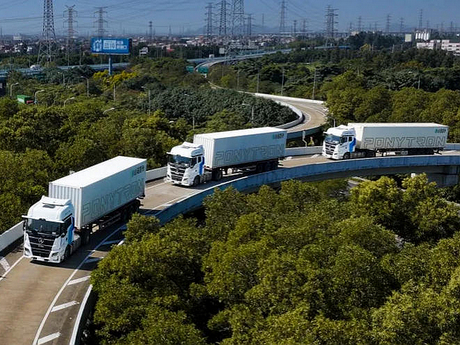
Regarding safety and reliability, this model is built upon SANY Heavy Industry's independently developed fully redundant drive-by-wire chassis platform. It covers six core systems—steering, braking, communication, power supply, computing, and sensing—forming a multi-level redundancy assurance mechanism. The vehicle has passed rigorous tests including electromagnetic compatibility and extreme temperature conditions, establishing a comprehensive system safety protection framework. This effectively enhances the operational stability of autonomous heavy-duty trucks in complex working conditions and elevates industry safety standards. In real-world operational scenarios, the fourth-generation autonomous heavy-duty truck has completed multiple pilot verifications. Calculations indicate that the “1+4” autonomous convoy transport model—where one driver-operated truck leads four driverless trucks—can reduce transportation costs per kilometer by approximately 29% and increase operational profits by about 195%. This model demonstrates strong replicability, offering an efficient, scalable solution for smart ports and long-haul logistics scenarios. Zhou Wanchun, Vice President of SANY Group and General Manager of SANY Heavy Truck Marketing, stated: “The mass production of fourth-generation autonomous heavy-duty trucks marks a significant milestone in SANY Group's digital transformation and low-carbon strategy. Our industry-leading fully redundant drive-by-wire chassis provides a reliable hardware foundation for autonomous driving. Through deep collaboration with Pony.ai, both parties are accelerating the large-scale application of intelligent logistics equipment, achieving simultaneous improvements in transportation efficiency and commercial value.”
Since establishing their strategic partnership in 2022, SANY Heavy Industry's technical expertise in electronic drive-by-wire chassis and vehicle engineering has complemented Pony.ai's strengths in autonomous driving algorithms and system integration. Together, they completed the world's first “5G + Autonomous Driving + Electrification” heavy-duty truck application demonstration, advancing the project from prototype validation to steady mass production. Through collaboration with Sinotrans, SANY and Pony.ai have further developed a deeply integrated “vehicle + technology + scenario” development model. This approach achieves efficient alignment between production capacity planning, technological maturity, and real-world operational scenarios, laying a solid foundation for the commercial deployment of autonomous heavy-duty trucks. As the fourth-generation autonomous heavy-duty trucks enter mass production, the industry will gradually transition from limited demonstration applications to large-scale, routine unmanned commercial operations. Through continuous breakthroughs in core technologies, safety systems, low-carbon performance, and commercial viability, SANY Group will join hands with Pony.ai to further advance the development of logistics transportation systems toward greater intelligence, efficiency, and environmental sustainability.
|